Showing posts with label Adam Bodger. Show all posts

Thursday, 17 September 2015

Everybody's got a story to tell

The generation now applying to and attending university are a generation of digital natives. They are generation Z and they are increasingly mindful consumers that require an open and transparent approach to our marketing. The world of social media is second nature to them and it will often be their first port of call when they want to share something with their peers.

It’s around 12 months ago now that I wrote about #MyChesterStory referencing the importance and value of referrals. It’s an idea that has helped us to narrate what it means to be a student at Chester, encouraging our students to share their stories with us. And on the eve of a new intake of students, it’s a concept we want them to engage with more than ever. We want our students to be proud of their University and shout out about it every step of the way, from enrolment all the way to graduation and beyond! Most of all, we want them to do this online in their social networks, where they and many of their peers often frequent.

Thursday, 7 August 2014

What is #mychesterstory?

I recently wrote some blogs discussing the importance and value of student referrals for enabling prospective students to gain an authentic view of the real student experience at Chester. It's these student experiences that enable our prospects to identify with the University in such a way that it allows them to envisage what it is really like to live and study at Chester. And it's our students' stories that help tell the story of our brand and consequently differentiate what we have to offer.

Wednesday, 2 July 2014

Higher Education Marketing with a Difference... Differentiation

Where shall I go to university?
How do you differentiate one university over another? Ask any senior marketing professional in the Higher Education sector and they’ll recognise the importance of differentiating what their university has to offer over that of another. Yet the truth of the matter is that, as soon as you look past a university’s location, upon first glance many universities can appear to be very homogenous and indifferent from their rivals. Of course, universities are defined by the types of courses they deliver, but a prospective student will often know what course they want to study, so it then becomes a question of how to differentiate your university over those with a similar set of programmes.

As the HE landscape continues to evolve and students become a far more discerning set of consumers, HEI marketing professionals recognise the need to demonstrate the benefits of what makes their institution stand-out from the competition. And to do this, key performance indicators, such as satisfaction or employability levels, are often used as a means to highlight a good return on a student’s investment. Of course, this is very important to do and something the government has advocated, which is only too evident through the introduction of Key Information Sets. But, if all universities are making similar claims, can they really be used as a means to differentiate? And besides, surely with so much data now available for prospects to sift through, this only leads to more confusion?


Tuesday, 4 March 2014

Marketing as Mad as the March Hare

At this time of the year, some of my marketing colleagues can appear to be a little reclusive. A sighting of them can be a rare privilege and when you do spot them, they can appear to be in a bit of a frenzy, rushing from one place to another. So what exactly is it that makes them behave like this, particularly at this time of the year? This short blog will clear up the reason for this elusive behaviour and explain why this might be of interest to you if you’re thinking ahead to the next recruitment cycle.

Hare, There and Everywhere...


The first week of March sees the start of our recruitment drive for September 2015. Whilst 2015 may seem a long way off, the next few months will see the Marketing team clocking up the miles as they travel the length and breadth of the country generating further interest in the University's provision of undergraduate courses.

Thursday, 13 February 2014

Applicant Day Checklist

With the University's Applicant Days now in full swing, I thought now might be an apt time to blog about how to get the most out of these days and ensure you maximise your chances of conversion. As with most blogs that I write, the core theme here will be centred on the premise of building a meaningful relationship with your attendees and leaving them with a lasting impression. I'm sure you'll agree that the tips contained within this blog are nothing ground-breaking, but perhaps instead more of a useful checklist for running successful subject sessions on an Applicant Day.

Tuesday, 17 December 2013

Engaging University Brand Advocates

In a service-led industry, such as higher education, customer referrals have a very important role to play in enhancing the reputation and value added aspects of the brand. Therefore, with this in mind, it is important that we do what we can to encourage positive feedback from students and staff alike.

Of course, in order to do this, first and foremost we need to be doing the basics right: provision of a quality service that adds value to the end user, all delivered with a good dose of customer care. Failure to do this will ultimately result in poor customer satisfaction and the rest will be history. However, if you get this right, then you’re likely to achieve high levels of customer satisfaction and be in a prime position to strategize on how to turn this into a means to market your course.

In marketing circles, this is often referred to as referral marketing or word of mouth. It’s a cost effective means to promoting your course(s) to new group of prospects.  And, whilst this can often happen spontaneously, you can influence this by adopting appropriate strategies.

Thursday, 17 October 2013

Another Open Day... Another Blog

It’s been while since my last blog, so with the advent of a new application cycle and the passing of another season of Open Days, I thought maybe now was the time for another blog about Open Days, with some reflection on their success and some thoughts on where we go from here.

Seeing Double


Of course, given the inclusion of an extra Open Day in the calendar, since this announcement there has been much debate as to how sensible the addition of an extra date was, especially over two consecutive weekends. One of the main incentives for doing this was to enhance the visitor experience. In recent years, the numbers attending Open Days have been steadily increasing and it was decided that it was in best interests of the visitor to split the main Chester Campus Open Day over two weekends.

I'm sure, to a certain degree, this debate will continue, but with the overall numbers in attendance far higher and more manageable spread over two dates, there’s a strong argument to say that we should continue with this formula next year. In reality, the extra date has now created far more choice for the visitor and, therefore, helped to increase overall attendance. This is important for us in order to maximise our chances of converting enquiries into applications, and it’s also helpful to our prospects at a time of the year when the majority of UK universities are trying to cram in their Open Days. And, given the nature of the application cycle, to move to another weekend later in the cycle would now be far too risky a strategy.

Monday, 8 July 2013

Identity Crisis: Football, Branding and Cardiff City

Identity Crisis: Football,
Branding and Cardiff City
In this blog, rather than focusing on marketing in the Higher Education sector, I thought it would be interesting to focus on another services sector that, like Higher Education, can be subjected to some resistance when the marketers take hold.  It is well known, of course, that football is now more than just a sport.  And over the last few decades we've seen many examples of how to, and how not to, run a football club as a business.

Of course, given my location, the natural thing to have done here would have been to write a blog on Chester Football Club.  It’s certainly had its fair share of turmoil over the last decade or so and would have made for an interesting case study.  However, given my sense of national pride, it’s only natural that I would look to focus my attention on the industry in the ‘land of my fathers’.

In particular, I thought we’d turn our attention to the topic of branding and whether it is possible, or even ethical, to re-brand a football club.  In one form or another, this is a matter most followers of Cardiff City have been debating about over the last 12 months.

Friday, 12 April 2013

Statistically Speaking, Visually Communicating


If you’ve seen our latest university promo, you’ll have noticed that there is a heavy use of graphics for illustrating various statistics and facts about the University.  The purpose of this film is to highlight why Chester is a sound investment for higher education; an upcoming university rising up the league tables and getting the recognition it deserves for the service it provides its students.  But why use infographics for narrating such achievements?  And what exactly is an infographic?

Thursday, 7 February 2013

Marketing School Direct

For those of you reading this with absolutely no responsibility for the recruitment of School Direct places, or the recruitment of any kind of teacher training course for that matter, you might think that there is little point in reading on. However, if you have a general interest in student recruitment and raising the profile of your course, I would urge you to stick with this blog, especially if you are concerned with ensuring the best return on your marketing expenditure. The marketing principles discussed within this blog really can be applied to any course at the University.

A Game Changer


A change of government policy and the introduction of a new course called School Direct not only changes the rules of the game but also presents new challenges for student recruitment. Raising the awareness of new course provision can often be a challenge in itself, but with School Direct this responsibility doesn't just sit with the university that the school, or group of schools, have decided to go into partnership with, but also with the school itself.

Monday, 3 December 2012

Read all about it

If you’ve read one of my previous blogs, you’ll probably be aware that one of the consistent themes is often based around the premise of creating a stronger bond with the prospect and developing some sort of sense of loyalty to the brand.  It’s fundamental to any business that wants to be successful or even survive.  And it’s why so many businesses now work so hard to encourage you to leave your personal details with them.  They want to know exactly who you are, and what your buying habits are, so they can begin to interact with you in a way that is relevant to you.  Customers are always the lifeblood of any organisation and universities are no different.

Whilst our immediate goal may not be repeat business, which is often the main objective of building brand loyalty, it is necessary to keep our prospects and applicants engaged and interested throughout the various stages of their decision making process.

Previously…


In my previous blog, I discussed the aftermath of the Open Day, putting it into context of where it falls in a prospect’s decision making process.  With applications now starting to flow into the admissions office, the process of making offers has begun.  Hence, it is now that the arduous task begins of trying to convert these applications into enrolments.

Extra, Extra… 


In terms of how you can begin to engage with your applicants, a department or course e-newsletter is a good starting point.  Universities are in a very fortunate position that makes it relatively easy to engage with our prospects.  By virtue of an applicant’s application, not only do we know that they are considering the University as one of their five choices, but we also have a wealth of information on exactly who they are and what they are interested in.  This immediately gives us the ability to create very powerful personalised and targeted marketing communications.

Friday, 19 October 2012

The Open Day aftermath - the difference between success and failure


With the Open Day season complete, we can all collectively breathe a huge sigh of relief and reflect positively on what worked well and what didn’t work so well.  All in all, I think all the University’s Open Days went very well with some record numbers in attendance, and I would like to congratulate Anna Long and Mark Hoddell for doing a sterling job in co-ordinating these events.  Months of blood, sweat and tears go into ensuring these events run without a hiccup.  Okay, maybe I’m exaggerating a little, but they work flaming hard at making them a success.

Step in the right direction


In an earlier blog, I talked about the difference an Open Day can make to prospective students, with it often a determining factor on whether or not to apply.  With the encouraging numbers in attendance and the fact that so many departments put so much effort into making the Open Day experience a positive one, it would be an easy mistake to make to think that the task of marketing your course is now done.  Far from it unfortunately, but a successful Open Day is obviously a step in the right direction.

Wednesday, 18 July 2012

What a difference a day makes


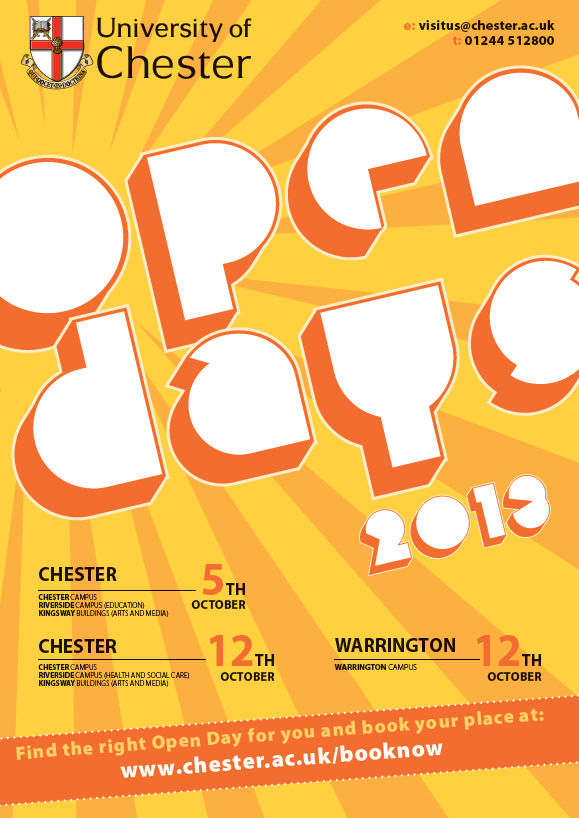
No, this isn’t a blog about the popular song as sung by Dinah Washington, but rather a blog about our forthcoming Open Days in October.   In a service led industry where our product is intangible in nature and, to a great extent, consumed at the same time as it is produced, Open Days have always been an important marketing tool for showcasing what we can offer prospective students.  However, it could be argued that the recent rise in tuition fees means that the role of Open Days is now more important than ever, with prospective students scrutinising every aspect of this investment closer than ever before.  A number of universities have already reported Open Day attendances increasing as a result of this.

Monday, 14 May 2012

A Guide to Conversion: Engaging and Maintaining Student Prospects through Relationship Marketing (Part Two)

The Saga Continues


In my last blog we talked about the importance of implementing a successful relationship marketing strategy and began to look at how this works in practice.  You may recall that I introduced you the model shown below.  Let’s now take a closer look at what is happening at each stage.

The Decision Making Process

Wednesday, 2 May 2012

A Guide to Conversion: Engaging and Maintaining Student Prospects through Relationship Marketing (Part One)

Are you sitting comfortably?


Then I’ll begin. 

Getting to the point
Well actually, maybe I won’t start quite yet because I thought I should précis my first blog with a bit of an apology. Despite the fact that, when it comes to advertising copy, I strongly advise to keep it short, otherwise no one will read it, I guess this is a case of not practicing what I preach! Therefore, in order to try and keep you engaged, I’ve decided to do this blog in two parts. No cliff hanger I’m afraid, unless of course my first blog leaves you keen to find out more! I should probably also apologise for my blog being more like a marketing tutorial, but I thought this might be a good starting point to help you understand what Marketing, Recruitment and Admissions (MRA) do to recruit students.

OK, now I’ll begin.