Showing posts with label Chester. Show all posts

Monday, 12 May 2014

Campus Tours: Where, When and Why?

With the 2014 Applicant Day cycle now over (*collective sigh of relief*), I thought it would be a good time to mention our campus tour provision at the Chester and Warrington campuses.

Applicant Days – done!


The Applicant Days have seen upwards of 2,500 applicants - plus associated parents / siblings / friends / partners / babies - pass through our doors over the last few months.  An increase of around 10% on last year’s Applicant Day attendance, this is a great outcome for making our offer more tangible to those applicants who visit us.  We know that conversion rates are significantly higher for people who have attended Applicant Days, and research shows that, however much applicants research into their chosen courses and institutions, the final choice ultimately comes down to whether or not a university ‘feels right’.

Getting a feel for the place 


Providing opportunities to visit the University is therefore a really important part of recruiting students, and booking onto Open Days and Applicant Days is a key call to action in much of our communications with applicants throughout the recruitment cycle.

Despite encouraging attendance at recruitment events, there will always be people who have missed or not been able to attend Open Days and Applicant Days, as well as those who apply late, or are simply slightly disorganised...

Thursday, 17 October 2013

Another Open Day... Another Blog

It’s been while since my last blog, so with the advent of a new application cycle and the passing of another season of Open Days, I thought maybe now was the time for another blog about Open Days, with some reflection on their success and some thoughts on where we go from here.

Seeing Double


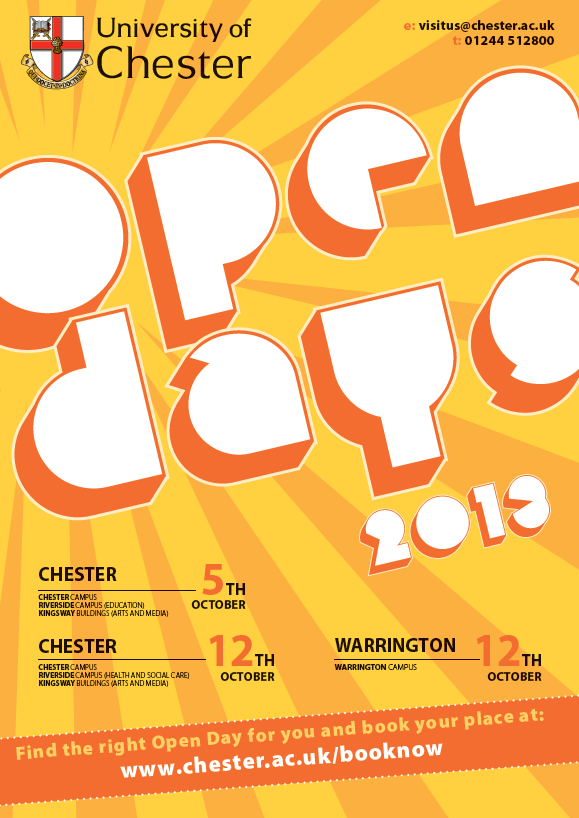
Of course, given the inclusion of an extra Open Day in the calendar, since this announcement there has been much debate as to how sensible the addition of an extra date was, especially over two consecutive weekends. One of the main incentives for doing this was to enhance the visitor experience. In recent years, the numbers attending Open Days have been steadily increasing and it was decided that it was in best interests of the visitor to split the main Chester Campus Open Day over two weekends.

I'm sure, to a certain degree, this debate will continue, but with the overall numbers in attendance far higher and more manageable spread over two dates, there’s a strong argument to say that we should continue with this formula next year. In reality, the extra date has now created far more choice for the visitor and, therefore, helped to increase overall attendance. This is important for us in order to maximise our chances of converting enquiries into applications, and it’s also helpful to our prospects at a time of the year when the majority of UK universities are trying to cram in their Open Days. And, given the nature of the application cycle, to move to another weekend later in the cycle would now be far too risky a strategy.

Friday, 12 April 2013

Statistically Speaking, Visually Communicating


If you’ve seen our latest university promo, you’ll have noticed that there is a heavy use of graphics for illustrating various statistics and facts about the University.  The purpose of this film is to highlight why Chester is a sound investment for higher education; an upcoming university rising up the league tables and getting the recognition it deserves for the service it provides its students.  But why use infographics for narrating such achievements?  And what exactly is an infographic?

Monday, 11 March 2013

Prospectuses, prospectuses

It's around this time of year that we publish a new Undergraduate Prospectus, and so it seems a timely opportunity to inform you more about the process of creating our printed prospectuses, as well as why we do it. The following post covers:
  • The University of Chester's 2014 Undergraduate Prospectus - available now
  • An explanation of the Marketing Department's prospectus timelines
  • Why our prospectuses are important marketing materials
Undergraduate and Postgraduate Prospectuses
The 2014 Undergraduate and 2013 Postgraduate Prospectuses

Tuesday, 4 December 2012

Applicant Days - Successful Subject Sessions

With winter setting in and the Christmas break not far away, it’s time to think ahead to next year’s Applicant Day cycle starting in January.  From now onwards and throughout the spring term, applicants will be receiving offers from their prospective institutions.  Their task is now to hone their five or so application choices and decide where they really see themselves studying and living for the next three or more years. And that’s where Applicant Days are designed to help.

By the time Applicant Days come around, the priority for most applicants is figuring out the distinctions between courses at different universities.  It’s likely that they’ll be visiting elsewhere too, and directly comparing institutions and courses.  Our cycle of Applicant Days running between January and the start of May provides opportunities for applicants to visit us throughout the period that sees their offers come in and decisions having to be made. 
The subject sessions at Applicant Days are the perfect opportunity for departments to engage with their applicants at this stage in the application cycle and really show off the many benefits of our courses.  It’s then our job in MRA to build the rest of the days around these sessions and help reinforce the value of the whole ‘Chester Experience’ – the result hopefully being to convert attendees into budding 2013 entrants. 
I’ve been having a look at some of the survey feedback about what prospective students most enjoyed about last year’s Applicant Days, plus things they thought could be improved upon.  A summary of this data will be forwarded to Faculty Deans over the next couple of months.
In the meantime, here are a few illustrative quotes from last year’s survey and our top tips for planning successful subject sessions.

Friendly information from the experts

Given that applicants are taking the time to visit us to find out more about their course, it’s important that they’re able to meet with relevant subject staff where possible.  Being able to meet and ask questions of the people who will actually be teaching them leaves visitors better informed and able to envisage what their time with the Department will be like.  Previous visitors have also been impressed with the friendliness of staff and an altogether personable approach that really helps Chester stand out from the crowd: 
"I liked the relaxed, friendly atmosphere” 
“Very friendly and welcoming Professor, plenty of opportunity for questions” 
“I was pleased to meet a member of staff I will be working with in the future” 
“A specific course teacher would have been helpful” 
“It would have been nice to have talked to someone who actually ran the course”

Help from current students

Of course, the real experts in student life at Chester are our students!  We know from visitor feedback there’s nothing better than getting information straight from the horse’s mouth.  Involving current students in subject sessions -  perhaps through Q&As or tours of the department -  is a great way of contributing to the day’s personal touch , not to mention a great resource and help to staff.
  “There were students from first and second year speaking which helped to get a feel for the university from a student’s point of view”

Timely and relevant information

A number of those who decide to visit us on an Applicant Day will have already visited us at one of our recent Open Days.  It’s worth being mindful of this when planning what you will be delivering on Applicant Days as it shouldn’t simply be a case of repeating the same old formula.   
“It was disappointing that it was exactly the same information and presentation that I had received on the Open Day I attended”
 Notwithstanding this, remember that our visitors are further along the applicant ‘journey’ than before they applied: they will now be seeking specific information about modules, field trips, assessment methods and so on, and comparing this to their other offers.  They are also likely to be in a better position to absorb positive messages about graduate employability at this stage; another key area for differentiation between institutions.

Keeping it informative, engaging and professional

… Not too much of a tall order, right?!  First and foremost, applicants want to come away equipped with in-depth, relevant information about what their chosen course will entail.  But as the recent parent’s blog post on our campaign site highlights, visits to events like Applicant Days are all about getting a ‘feel’ for the place and people at a university.  We’ve had some great feedback from applicants who have been really inspired by meeting enthusiastic staff and students, seeing departmental facilities and engaging in activities as part of the subject sessions:  
“Great tutor.  Interaction.  Ability to ask questions.  Good to see equipment”  
 “I enjoyed it when we did a small workshop as it was fun and not too pressured”   
“I enjoyed seeing the facilities and previous students’ work”   
“We enjoyed the way [the tutor] sold both the course and the University.  He was informative, interesting and held our attention throughout the session” 
This is all worth thinking about when planning the format and delivery of your sessions.  In terms of timing, do make sure to use the full time allocated for the subject sessions (this is your one chance to really sell the course – seize it!).  Equally, please make every effort not to overrun as delays tend to impact on the rest of an applicants’ day, which was noted by some in last year’s survey feedback.
Of course, there are always going to be latecomers, and occasions where the best planned schedules go awry!  Due to the variety of our programmes and the nature of Applicant Days as being designed around applicant choice, it’s inevitably difficult making ‘one size fit all’.  The best feedback from staff and students has been where sessions have been adaptable and  tailored to fit the occasion – often, this is when we are able to demonstrate Chester’s personal touch at its best:
“It was small and informal ... it made it very easy for me to ask any questions and get the most out of my day” 
Finally, think about the overall impression given by the materials you use on the day and update them as required.  If you’d like any advice on printed materials or would prefer to use a PowerPoint template that integrates with other materials used by MRA, please let us know.
Myself and Mark Hoddell will be in contact with relevant colleagues about the forthcoming Applicant Days – but if you do have any questions or queries in the meantime please get in touch:
  
Thanks all,

Anna

Monday, 3 December 2012

Read all about it

If you’ve read one of my previous blogs, you’ll probably be aware that one of the consistent themes is often based around the premise of creating a stronger bond with the prospect and developing some sort of sense of loyalty to the brand.  It’s fundamental to any business that wants to be successful or even survive.  And it’s why so many businesses now work so hard to encourage you to leave your personal details with them.  They want to know exactly who you are, and what your buying habits are, so they can begin to interact with you in a way that is relevant to you.  Customers are always the lifeblood of any organisation and universities are no different.

Whilst our immediate goal may not be repeat business, which is often the main objective of building brand loyalty, it is necessary to keep our prospects and applicants engaged and interested throughout the various stages of their decision making process.

Previously…


In my previous blog, I discussed the aftermath of the Open Day, putting it into context of where it falls in a prospect’s decision making process.  With applications now starting to flow into the admissions office, the process of making offers has begun.  Hence, it is now that the arduous task begins of trying to convert these applications into enrolments.

Extra, Extra… 


In terms of how you can begin to engage with your applicants, a department or course e-newsletter is a good starting point.  Universities are in a very fortunate position that makes it relatively easy to engage with our prospects.  By virtue of an applicant’s application, not only do we know that they are considering the University as one of their five choices, but we also have a wealth of information on exactly who they are and what they are interested in.  This immediately gives us the ability to create very powerful personalised and targeted marketing communications.

Friday, 19 October 2012

The Open Day aftermath - the difference between success and failure


With the Open Day season complete, we can all collectively breathe a huge sigh of relief and reflect positively on what worked well and what didn’t work so well.  All in all, I think all the University’s Open Days went very well with some record numbers in attendance, and I would like to congratulate Anna Long and Mark Hoddell for doing a sterling job in co-ordinating these events.  Months of blood, sweat and tears go into ensuring these events run without a hiccup.  Okay, maybe I’m exaggerating a little, but they work flaming hard at making them a success.

Step in the right direction


In an earlier blog, I talked about the difference an Open Day can make to prospective students, with it often a determining factor on whether or not to apply.  With the encouraging numbers in attendance and the fact that so many departments put so much effort into making the Open Day experience a positive one, it would be an easy mistake to make to think that the task of marketing your course is now done.  Far from it unfortunately, but a successful Open Day is obviously a step in the right direction.

Wednesday, 18 July 2012

What a difference a day makes


No, this isn’t a blog about the popular song as sung by Dinah Washington, but rather a blog about our forthcoming Open Days in October.   In a service led industry where our product is intangible in nature and, to a great extent, consumed at the same time as it is produced, Open Days have always been an important marketing tool for showcasing what we can offer prospective students.  However, it could be argued that the recent rise in tuition fees means that the role of Open Days is now more important than ever, with prospective students scrutinising every aspect of this investment closer than ever before.  A number of universities have already reported Open Day attendances increasing as a result of this.

Monday, 18 June 2012

Fusion: Looking outside the world of HE

Recently, I was asked to write a book review for Euro RSCG People's Education Marketing Magazine. It's a publication that's well read by HE marketing professionals and this was an interesting opportunity that I wanted to investigate. 


I had been reading a fascinating marketing book and when I suggested it as the topic of the review, the publishers were happy with the choice. They agreed that it's useful to look outside HE when considering marketing planning and so I was set the task of writing 400 words on the book Fusion: The New Way of Marketing by David Taylor and David Miles. It's surprising how little you can say in 400 words, but I gave it a go and the resulting review was published in the magazine last month.

I've reproduced it here for you to take a look at. The book is a pretty interesting read and, while I wouldn't recommend it as a pool-side page turner, it's worth a look if you are interested in where we can take marketing given the remarkable opportunities that present themselves to us today and in the future...

Fusion: The New Way of Marketing

David Taylor & David Miles
Ecademy Press
2011
ISBN: 978-1-907722-35-6
www.fusionbook.co.uk

‘Fusion: The New Way of Marketing’ is a book that practices what it preaches. This is a book and e-book download that enjoys 100% five star reviews on Amazon and has its own website, Facebook page and twitter profile. Its aim, we are told, is to ‘demystify the internet’ and show us how to harness the power of new technologies to help us fulfil our marketing objectives.


An excellent read
Usefully, ‘Fusion’ isn’t about higher education. By stepping away from our everyday concerns and considering the reach and scope of the modern, digital world, we are able to take the time to do some of our most creative thinking. And this book will get you thinking. From the beginning, it sets out the idea that we now have a completely new and democratised way of accessing and sharing information. This hasn’t just changed the way we communicate with one another as individuals, it has completely changed marketing. Understanding how to connect the two is the key, and this gives us an insight into the book’s core message: the world has changed and unless we embrace this new world bravely, our marketing efforts could fall by the wayside.

We are told that the key is to get your website to the heart of your marketing activity and, by carefully assessing some marketing basics, to get marketing to the heart of your website. By getting your website right and developing a strong online marketing strategy around it, you will benefit enormously from social media, pay per click advertising,
                                                            SEO, analytics and interactive media.

The article in print
Of course, we all know that we should be using online technologies and social media but unless we do so in a well thought out and integrated way then there is no point. And this is the other core message of the book:  get the basics right.  Having an out of date marketing strategy that doesn’t appreciate the enormity of the opportunities or that deals with emerging new media in a piecemeal fashion is a recipe for disaster. If you are going to do it, understand it and do it right (and keep re-educating yourself). 

The true value of ‘Fusion’ is that it contextualises online and digital technologies in a traditional marketing sense. For the ‘non-techie’ marketer this is especially useful. And the reminder to first get back to basics is refreshing – each chapter’s suggested action plan, web and video links encourage us to ask ourselves the key questions that underpin a true marketing strategy. But perhaps most pertinently of all, given the times we live in, ‘Fusion’ asks us to re-think what we do (and why we do it) and focus on making our work more efficient by ‘using our brain instead of our bank account’.

Thanks for reading,

Ric.


Thursday, 24 May 2012

Open Day - A BIG Thankyou!


We are now only a day or so away from the Open Day. It has been a huge task to complete all of the necessary work required, both from a marketing perspective as well an academic one, but yet again we have risen to the challenge superbly.

The Open Day guide looks great, so well done to Anna Long for co-ordinating all of the content, and to me (Stuart Grant!) for the design, artwork and for arranging the print. There was a huge influx of briefs to us, from banner stands and wrap-around displays, to course leaflets, posters and flyers...and also a lot of new and updated web content too.

Not forgetting

A BIG thank you to all of the academic staff who supplied their written briefs in time and to our design and web teams, admirably led by Marc Kneebone (who also designed lots of the printed material) and Neil Martin on web.

We have many heroes in proof reading, editing and printing, but it's been a fantastic team effort in general. The event itself on Saturday will see many of our team doing their bit to provide potential students with a great experience of the University.


All the best for the BIG day!


Stuart


Monday, 21 May 2012

Outreach, simply reaching-out? (Part 1)

How do we define Outreach? Can we define it or is it simply 'reaching out'? 

Now I'm not much of a wordsmith, but I've always looked to the Oxford English Dictionary as first port of call for any of my referencing needs (those of you lucky enough to read my dissertation will certainly agree!).

Definitions

  
They define Outreach (as a verb), as 'To hand out, or over. To present, give' while another definition sees it as 'To exceed or go beyond bounds; to stray'. I really like the term 'stray' as I think it best defines what we do, and why we do it. Whether it is the boundaries of access to University, or the very nature of communicating with organisations outisde of our own, I like to think we're always looking to 'spread the word', or 'stray', across a few barriers.

As I have a tendency of going into great detail (!), I've decided to take the first Outreach blog in two parts. Be sure to look out for Part 2 in the coming days where we'll look at what Outreach actually looks like to a possible student.


Now how do I start to explain the changes in the Outreach Office over the past two years? It’s a tricky task, but one I’m willing to have a go at. Be prepared for a rollercoaster ride through government policy, aspirational plans, and one persons journey through the whole process!


Outreach?

At Chester our Outreach Office comprises of seven of us in all, with schools and college’s liaison activity and our department’s widening participation activity, combining into one unit over two years ago. This meant that all communication from our department with schools and colleges would be co-ordinated through the work of Outreach, as well as working towards being aware of the communication being made between the wider University and these institutions.

Wordle: The Browne Report

Some of these changes were made before the Browne report and before the Coalition Government’s announcements of changes to the funding system for those starting higher education in 2012. This meant we were very well placed to add three members of staff at the beginning of this year, to meet the needs of a quickly changing HE climate in this country.
 
Through all the media coverage of what’s been happening in higher education over the past few months, there have been repeating themes, terms, and questions, being thrown about by the media and the sector.

  • How do we ‘widen participation?’
  • What ‘outreach’ activity are Universities involved in?
  • The students as a 'consumer'
  • The overall issue of Social Mobility

Hopefully through our updates you may be able to understand how we’re working to solve some of these. Now put simply, there are two distinct areas which Outreach covers, and explains the different types of activity we're involved in;

"Widening Participation & Recruitment"


There are age groups, and students, who may interact with both areas throughout their school or college experience, and it's important we're aware of their requirements. As pupils become students, and students become consumers, the Outreach process is involved in every step of their journey.

End of Part One...


Although relatively brief, I'm sure you'll agree that the scope of Outreach is rather large across the entire University, and society beyond. We haven't yet got to 'Joe' and his educational journey, but as an introduction to the topic of Outreach, I hope you've found it insightful.

Thank you reading, and be sure to tune in next time.

Sean


Monday, 14 May 2012

A Guide to Conversion: Engaging and Maintaining Student Prospects through Relationship Marketing (Part Two)

The Saga Continues


In my last blog we talked about the importance of implementing a successful relationship marketing strategy and began to look at how this works in practice.  You may recall that I introduced you the model shown below.  Let’s now take a closer look at what is happening at each stage.

The Decision Making Process

Wednesday, 2 May 2012

A Guide to Conversion: Engaging and Maintaining Student Prospects through Relationship Marketing (Part One)

Are you sitting comfortably?


Then I’ll begin. 

Getting to the point
Well actually, maybe I won’t start quite yet because I thought I should prĂ©cis my first blog with a bit of an apology. Despite the fact that, when it comes to advertising copy, I strongly advise to keep it short, otherwise no one will read it, I guess this is a case of not practicing what I preach! Therefore, in order to try and keep you engaged, I’ve decided to do this blog in two parts. No cliff hanger I’m afraid, unless of course my first blog leaves you keen to find out more! I should probably also apologise for my blog being more like a marketing tutorial, but I thought this might be a good starting point to help you understand what Marketing, Recruitment and Admissions (MRA) do to recruit students.

OK, now I’ll begin.

Wednesday, 25 April 2012

Standing out from the crowd - Welcome to the University of You

In an earlier blog post, Neil mentioned something called the ‘University of You’ campaign. Conscious that much of our work isn’t seen by the wider University community, I think that it’s important to explain some of the concept and campaign planning that goes into recruiting new students. In doing this, you’ll get a better feel for what we do, why we do it, and how we plan and integrate our activities.

So, what on earth is the ‘University of You’ campaign? 

Well, every year we face increasing competition to generate applications for our undergraduate courses and every year it becomes more important to work smartly while really trying to stand out from the crowd. Factor in the changing HE landscape for 2012 entry and we figured it was more important than ever to speak to our prospective students through the channels that they use while addressing their concerns.

So, the ‘University of You’ campaign is our 2012 undergraduate recruitment campaign. It’s the plan we put together to generate the 20,000 applications that we are now working with to secure our 2012 intake. The campaign is based on the simple premise that by working directly with our prospective students to build meaningful relationships, we stand a far better chance of generating a high number of applications from a well informed and engaged group of individuals.

Planning

Planning campaigns is always fun. Over a number of sessions we get the team together to thrash out ideas and concepts. We work and rework ideas, change artwork and strategy and end up… sticking lots of brightly coloured post-it notes to our walls:

My office wall – where the magic happens
But while we try to be as creative as possible at this stage, we always make sure we focus on developing and keeping to a set of core messages. These key principles then inform the entire campaign that follows.

For 2012 entry, our core messages were created to speak directly to our prospective students and to address the issues pertinent to them while at the same time attempting to differentiate the University of Chester from other universities.

There were numerous messages that we needed to get across in this campaign:

  • The benefits of a university experience
  • Value for money 
  • Employability and careers
  • Uniqueness – augment your studies with a range of experiences to make yourself unique
  • Specific combinations
  • Risk reduction – why choosing Chester is not a risky option
  • Stories – the real-life of the University

However, there had to be a key overarching theme to hook our prospects. And this is what we went for: Personalisation. 

By placing the student at the heart of everything we do and offering an amazing mix of additional opportunities, our graduates can really stand out in the fierce graduate job market of the future. And that, in a nutshell, is the core message of the campaign: Choosing the University of Chester gives you so much freedom and support to develop as an individual that it really is the University of You.

Execution

So, satisfied with our concept and our core messages, we set out to create an engaging and fresh multimedia campaign that would generate interest in the University and encourage prospective students to interact with us.

As I’ve said, we love a bit of direct marketing here in MRA and what better way to get the ball rolling than with a piece of targeted direct mail? Armed with a database of hot leads (segmented by the course individuals were interested in applying for) we hit the doormats of around 55,000 prospects in the first weeks of September 2011 at exactly the time they would be thinking about getting their UCAS forms for 2012 entry completed. Why direct mail? Well, firstly it’s harder to ignore than an email, a text message or a printed advert and, secondly, because of who else would see it. We wanted parents to engage with the campaign too and learn about the benefits of their offspring applying to Chester.

As Neil has mentioned before on the blog, we don’t communicate with prospects without a call to action. And the call to action here was clear. We had created a beautiful stand-alone website filled with the core messages of the campaign and we wanted to drive traffic to it.

Phase one. Getting the message out there
The University of You phase one campaign website was a genuinely engaging and user friendly experience. Quirkily designed to help differentiate us from the competition, the site navigated left to right across the user’s screen rather than up and down like a traditional website. It was filled with snappy content and bespoke video and generated excellent feedback from users. Most importantly, it really started to hammer home our key messages and its own call to action – to order a prospectus or to book for an Open Day.

The site was ably supported online by bespoke University of You Facebook and twitter content and its success was shown by massive October Open Days and an unprecedented level of interaction with prospective students. 

But where are we up to now? Well, the campaign isn’t over and now we have moved into a second, ‘conversion’ phase. We all know that generating a high number of applications is important but converting these expressions of interest into students is the key and phase two, the applicant zone, launched in February of this year to coincide with the end of the on-time application cycle and keep our applicants engaged with the 'University of You' message.

Results

Has it worked? Yes, the evidence would suggest that the campaign has been successful. Of course, we won’t know the final outcome of 2012 recruitment until later on in the year but what we do know is that the level of engagement we have had with our applicants this year has been better than ever (more on this to follow from Adam) and that the messages we worked so hard to create and communicate are really getting across.

What’s perhaps most important is where the campaign has taken our thinking as a department. The look and feel of the campaign now informs much of what we do and this adds great strength to how we are perceived and understood in the marketplace.

The message goes on…
The campaign has really refreshed our thinking and brought renewed clarity to the way we communicate with prospective students. And what’s most important is that the messages are rooted in truth. We really do have a unique offering here at the University. There really is enough to offer our students to augment their course so that they can stand out as unique graduates in a crowded marketplace. It’s something we should all be very proud of.

Until next time…

Cheers,

Ric.

Wednesday, 28 March 2012

Bridging the gap between print and web


Back in October 2011 we sat down, cups of tea and flipchart paper at the ready, to work out what we wanted to achieve from the forthcoming 2013 Undergraduate Prospectus.


The marketing team headed by Adam (Bodger) was keen to build on the successes of undergraduate conversion or (in simple terms) bump up the amount of students that choose Chester and stick with us!

These successes had been built on improved efforts in relationship marketing with increased communication, interaction and engagement through a variation of direct mail, website and social networking.

But before Marc (Kneebone), sporting his graphics pen and notepad, could get creative with his Apple Mac, I was keen to see if we could bridge the gap between print and web.

This wasn’t just because I am sad geek, championing the website at every given opportunity, but also because printed materials can often only form part of the mission. For example, say a student picks up a leaflet or maybe takes a Prospectus at UCAS fair - what is it that we ultimately want them to do?

Maybe it’s to find out more information, or get in contact with someone, hey it may be just to simply know who you are and what you’re all about.

If it’s the latter you may think that all you require is killer content, punchy facts about the programme or department and some eye catching images, right? Well, yes… but you may want to consider what you want the individual to do after digesting this dazzling piece of marketing material. This is what us Marketers speak of as ‘Call to Action’, something that if any of you have ever had the pleasure of sitting in a meeting with either myself, Ric (Bengree) or Adam have witnessed us getting rather animated about.


What is a Call to Action, I hear you shout?

Well, a call to action is simply something on a print or web page that motivates or encourages a reader/user to do something.


Why are they useful, you may say?

They are excellent to keep individuals engaged (or as Adam would say ‘hot’), but also for measuring the success of a particular printed material.


With this in mind we agreed that we needed a campaign that:
  1. Engaged potential students
  2. Bridged the gap between print and web
  3. Something that was to go beyond the basic “for more information visit www.chester.ac.uk”
  4. Maintained the marketing message of the University of You campaign
  5. Reduced the risk for potential applicants
  6. Was measurable

To achieve the aims of this campaign we firstly looked at what the core aims were in the 2012 undergraduate recruitment campaign titled the University of You campaign.

As part of the 2012 recruitment campaign, MRA have implemented a ‘University of You’ campaign, where we are putting the applicant at the centre of everything we do. With 2012 set to be the first year when students start to pay the higher tuition fees, applicants are likely to be looking closely of what they are getting in return for their investment. What can one university offer them that perhaps another can’t? We have implemented this theme throughout all our current marketing for 2012, remembering that applicants decisions are made on an entirely self-referenced basis:
  • how does this affect me?
  • what do I get out of this?
So we are trying to keep our messages very personal and have an ‘all about you’ approach.

The Concept

The agreed concept was to promote the benefits of the University of Chester, through current students rather than any marketing spin. This, in essence would enable the potential student to hear about real experiences ‘straight from the horse’s mouth’.

Execution

To execute this concept we planned the prospectus to have miniature profiles with each individual student's quote about their programme, student life, opportunities whilst here as well as much more.

The student profiles were to span throughout the prospectus, but each profile in the prospectus would direct readers to an area of the website with more information about the student.

Now at this point, it would have been easy to ask for some content from a department (one of you guys) and create a page on the website, but that would have firstly increased the bounce rate of the website (visitors landing on our website and jumping straight off it), but also not fully satisfy the overall aims of the campaign. So this is what we did…

Contacted each student and organised for them to be involved firstly in a photo-shoot and then a one to one video interview. Now you can imagine the prospect of getting a substantial number of students to firstly commit to a photo-shoot and then a video interview as being slim to none, but if you know me I don’t take no as an answer.

Anyway, we organised it (well, I did), shot it (well, Marc did) and edited it and it was ready for the web. Both Annabelle (Davies) and Lee (Bennett) did a sterling job teasing out the best answers and trimming down an hour long video for each student into an entertaining 1 to 2 minutes clip.

Next up, me and Marc sat down and laid out what we wanted from the website in terms of design and content. We agreed a design that focused on presenting information in a visually engaging way, bringing together style cues from the prospectus, with splashes of fresh colours and fonts as well as some funky wallpaper courtesy of (Ian) White’s Dining rooms.

Also, to complement the content in each video we created a miniature fact file and image gallery for each student, as created by Angela (Evans). This gave each profile a good basis of information about the student, and we felt it was more likely to engage our target audience than having bags of text.

Measurability

So, after the web pages were designed and built, you might think, 'job done', but we had one final box to tick, and probably one of the most important.

As the title suggests, we had to put our heads together and agree how to measure the success of this campaign. Of course this was done prior to the design phase, but I didn’t have enough room to fit it in up there (odds on I’m not going to be submitted for the Booker Prize for literature).

Any way back to the story, we agreed that we could measure the success of this campaign through clear calls to action. Firstly, each student profile on the website would have a bespoke URL (web address) set up, which would track visitors who had got the URL from the 2013 prospectus.

In addition both Shai and Adam were keen and a little giddy about the power of using QR codes.

QR codes work in the following way, first point your phone (has to be a smart one, so your Granddad’s Binatone isn’t going to cut it) at a printed page. Take a picture. Get taken to a website. It is that simple, and from a user’s point a view, very cool.

With the QR Code set up Shai (Vure) ensured that we could track these smartphone visitors from the prospectus to the website. All in all with tracking set up for direct visitors via the prospectus URL’s and QR codes we could measure the success of bridging the gap between print and web.

Recap

I believe this campaign really adds value to both print and web, whilst also emphasising the key messages of the original University of You campaign. Hopefully this has given you an insight into how a fully planned marketing campaign can be set up, delivered and measured.

Check out the finished campaign website - Meet the Students


With myself and Marc heading up Marketing communications whilst Sarah (Steele) is away with newly born baby Henry, we hope to bring you more on marketing communications, as well as any interesting snippets along the way.

This is the first of a fresh and constant Blog from Marketing, Recruitment and Admissions – so watch this space for more posts in the near future.


Toodaloo,


Neil