Thursday, 17 September 2015

Everybody's got a story to tell

The generation now applying to and attending university are a generation of digital natives. They are generation Z and they are increasingly mindful consumers that require an open and transparent approach to our marketing. The world of social media is second nature to them and it will often be their first port of call when they want to share something with their peers.

It’s around 12 months ago now that I wrote about #MyChesterStory referencing the importance and value of referrals. It’s an idea that has helped us to narrate what it means to be a student at Chester, encouraging our students to share their stories with us. And on the eve of a new intake of students, it’s a concept we want them to engage with more than ever. We want our students to be proud of their University and shout out about it every step of the way, from enrolment all the way to graduation and beyond! Most of all, we want them to do this online in their social networks, where they and many of their peers often frequent.

Wednesday, 17 December 2014

Postgraduate Student Loans


As you may be aware, George Osborne announced plans for postgraduate student loans for 2016 in his Autumn Statement. I have collated the main points of this announcement in a bid to help identify the: Who, what, when and how’s and the potential opportunities to the University and ‘young’ graduates; in addition to what implications this may have on our marketing and recruitment work.

Monday, 17 November 2014

Email Marketing Tips

Email marketing is a key tool and is used throughout the student recruitment cycle. However it’s not as simple as just sending an email, there are lots of things to consider to ensure that people receive targeted emails that are relevant to them, we don’t just want to bombard people otherwise they will only ignore our emails.

To make sure that emails are sent to the correct people at the right time and contain useful content, there’s a useful acronym CRITICAL. I will explain what each of the letters stand for.

Monday, 27 October 2014

Digital Marketing Top 10

In July and September I had the opportunity to present my 'Digital Marketing Top 10' to colleagues in MRA and at the wider Staff Conference. I recorded the first of these sessions and if you'd like to view it, it's available in the YouTube player below. Alternatively, if you'd like to skip through the presentation at your own pace (and without my ramblings) you can do so using the Prezi player.

Thursday, 7 August 2014

What is #mychesterstory?

I recently wrote some blogs discussing the importance and value of student referrals for enabling prospective students to gain an authentic view of the real student experience at Chester. It's these student experiences that enable our prospects to identify with the University in such a way that it allows them to envisage what it is really like to live and study at Chester. And it's our students' stories that help tell the story of our brand and consequently differentiate what we have to offer.

Wednesday, 2 July 2014

Higher Education Marketing with a Difference... Differentiation

Where shall I go to university?
How do you differentiate one university over another? Ask any senior marketing professional in the Higher Education sector and they’ll recognise the importance of differentiating what their university has to offer over that of another. Yet the truth of the matter is that, as soon as you look past a university’s location, upon first glance many universities can appear to be very homogenous and indifferent from their rivals. Of course, universities are defined by the types of courses they deliver, but a prospective student will often know what course they want to study, so it then becomes a question of how to differentiate your university over those with a similar set of programmes.

As the HE landscape continues to evolve and students become a far more discerning set of consumers, HEI marketing professionals recognise the need to demonstrate the benefits of what makes their institution stand-out from the competition. And to do this, key performance indicators, such as satisfaction or employability levels, are often used as a means to highlight a good return on a student’s investment. Of course, this is very important to do and something the government has advocated, which is only too evident through the introduction of Key Information Sets. But, if all universities are making similar claims, can they really be used as a means to differentiate? And besides, surely with so much data now available for prospects to sift through, this only leads to more confusion?


Wednesday, 21 May 2014

New On-line Design Brief...

The design brief is one of the essential parts of the design process. Starting a project without one is a bit like building a house without a blueprint. Although it may be possible to do, you may finish the house and then realize that you should have put the front door somewhere else!

So, what is a design brief?


A design brief is a document outlining the business objectives and design strategies for a project. It gets the design wheels rolling and helps us to think strategically about design solutions. It also encourages the client (you) to process and clarify what you need from a project, who the target audience is, and who the key stake-holders are.

How does a design brief relate to a marketing plan?


You could think of a marketing plan as the set of rules that direct your marketing activities. The marketing plan is simply a way to focus on one or more marketing objectives.

A successful design brief will inevitably be informed by your marketing plan. For example, if one of the objectives in your marketing plan is to target a specific age-group, this should be stated in your design brief. We can then use this information to propose design ideas that are coherent with your marketing plan.

Monday, 12 May 2014

Campus Tours: Where, When and Why?

With the 2014 Applicant Day cycle now over (*collective sigh of relief*), I thought it would be a good time to mention our campus tour provision at the Chester and Warrington campuses.

Applicant Days – done!


The Applicant Days have seen upwards of 2,500 applicants - plus associated parents / siblings / friends / partners / babies - pass through our doors over the last few months.  An increase of around 10% on last year’s Applicant Day attendance, this is a great outcome for making our offer more tangible to those applicants who visit us.  We know that conversion rates are significantly higher for people who have attended Applicant Days, and research shows that, however much applicants research into their chosen courses and institutions, the final choice ultimately comes down to whether or not a university ‘feels right’.

Getting a feel for the place 


Providing opportunities to visit the University is therefore a really important part of recruiting students, and booking onto Open Days and Applicant Days is a key call to action in much of our communications with applicants throughout the recruitment cycle.

Despite encouraging attendance at recruitment events, there will always be people who have missed or not been able to attend Open Days and Applicant Days, as well as those who apply late, or are simply slightly disorganised...

Tuesday, 1 April 2014

Adding Value for our Applicants - Newsletters 2014

The January - May decision making period (or Stage Two as we like to call it) of the Undergraduate recruitment cycle is of crucial importance to us all. At this time, an applicant will have applied to up to five institutions, each with their own marketing and recruitment teams doing their best to demonstrate why their university is the right choice for them.

Thursday, 20 March 2014

Our 2015 Undergraduate Prospectus - what's changed?

To give you a bit of background, the whole process of producing a prospectus (re-writing, editing, image selection, designing, proofing and printing) generally takes 4-6 months from start to finish, with the Undergraduate prospectus being produced between the months of October and February and the Postgraduate prospectus between the months of March and August.

In the months running up to the project we are busy collecting ideas, feedback and researching the direction we would like to head in.  We have to work 18 months ahead to cater for our stakeholders (prospective students, parents, teachers, careers services etc) as this is when they would typically start their research - so last month (February 2014) the 2015 Undergraduate prospectus was completed for students thinking about starting uni in September 2015.

The University's positioning in the HE sector has changed in recent years and the prospectus along with the rest of our marketing collateral needs to reflect that.  For the previous year's prospectus (2014) we focused on streamlining the content and reorganising the structure slightly to make it more user friendly.  This year we focused on imagery.  We organised a weeks professional photography to capture our students going about their daily lives, studying, socialising, working out, shopping.  We were keen to not just showcase the facilities we have but to show how students use these facilities in their day to day lives.  It all needed to be more 'human'.  We took new photos of students relaxing in the comfort of their own rooms, enjoying a catch up with their friends in the local pub, heading off to lectures and visiting the many support services we have to offer.  We captured students in their study environment, heading from one lecture to another. And the list goes on...


We hope you like the 2015 Undergraduate Prospectus as much as we do.  Initial feedback from prospective students at the HE Fairs has been really positive and we're confident that we're getting closer and closer to producing a document that gives a prospective student an honest and complete idea of what it's like to study at the University of Chester.

Tuesday, 4 March 2014

Marketing as Mad as the March Hare

At this time of the year, some of my marketing colleagues can appear to be a little reclusive. A sighting of them can be a rare privilege and when you do spot them, they can appear to be in a bit of a frenzy, rushing from one place to another. So what exactly is it that makes them behave like this, particularly at this time of the year? This short blog will clear up the reason for this elusive behaviour and explain why this might be of interest to you if you’re thinking ahead to the next recruitment cycle.

Hare, There and Everywhere...


The first week of March sees the start of our recruitment drive for September 2015. Whilst 2015 may seem a long way off, the next few months will see the Marketing team clocking up the miles as they travel the length and breadth of the country generating further interest in the University's provision of undergraduate courses.

Thursday, 13 February 2014

Applicant Day Checklist

With the University's Applicant Days now in full swing, I thought now might be an apt time to blog about how to get the most out of these days and ensure you maximise your chances of conversion. As with most blogs that I write, the core theme here will be centred on the premise of building a meaningful relationship with your attendees and leaving them with a lasting impression. I'm sure you'll agree that the tips contained within this blog are nothing ground-breaking, but perhaps instead more of a useful checklist for running successful subject sessions on an Applicant Day.

Tuesday, 17 December 2013

Engaging University Brand Advocates

In a service-led industry, such as higher education, customer referrals have a very important role to play in enhancing the reputation and value added aspects of the brand. Therefore, with this in mind, it is important that we do what we can to encourage positive feedback from students and staff alike.

Of course, in order to do this, first and foremost we need to be doing the basics right: provision of a quality service that adds value to the end user, all delivered with a good dose of customer care. Failure to do this will ultimately result in poor customer satisfaction and the rest will be history. However, if you get this right, then you’re likely to achieve high levels of customer satisfaction and be in a prime position to strategize on how to turn this into a means to market your course.

In marketing circles, this is often referred to as referral marketing or word of mouth. It’s a cost effective means to promoting your course(s) to new group of prospects.  And, whilst this can often happen spontaneously, you can influence this by adopting appropriate strategies.

Thursday, 7 November 2013

The Role of Student Ambassadors

Our recent Open Days were amongst the busiest we have ever had and pivotal to their success was the role of our student ambassadors.  More student ambassadors than ever before volunteered to help out at the Open Day, ready to do their part to advocate the University.  Student ambassadors were on hand to provide tours, show their accommodation, give directions and generally be a friendly and welcoming face.


Thursday, 17 October 2013

Another Open Day... Another Blog

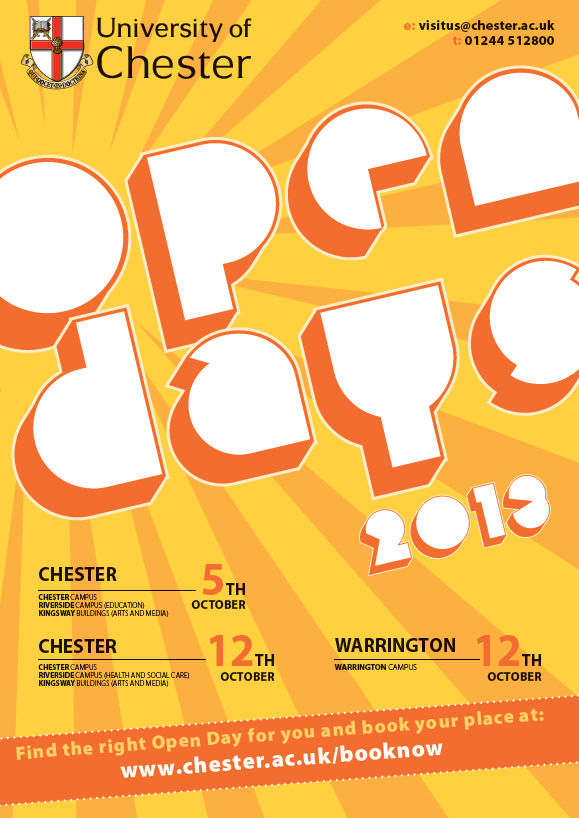
It’s been while since my last blog, so with the advent of a new application cycle and the passing of another season of Open Days, I thought maybe now was the time for another blog about Open Days, with some reflection on their success and some thoughts on where we go from here.

Seeing Double


Of course, given the inclusion of an extra Open Day in the calendar, since this announcement there has been much debate as to how sensible the addition of an extra date was, especially over two consecutive weekends. One of the main incentives for doing this was to enhance the visitor experience. In recent years, the numbers attending Open Days have been steadily increasing and it was decided that it was in best interests of the visitor to split the main Chester Campus Open Day over two weekends.

I'm sure, to a certain degree, this debate will continue, but with the overall numbers in attendance far higher and more manageable spread over two dates, there’s a strong argument to say that we should continue with this formula next year. In reality, the extra date has now created far more choice for the visitor and, therefore, helped to increase overall attendance. This is important for us in order to maximise our chances of converting enquiries into applications, and it’s also helpful to our prospects at a time of the year when the majority of UK universities are trying to cram in their Open Days. And, given the nature of the application cycle, to move to another weekend later in the cycle would now be far too risky a strategy.

Thursday, 25 July 2013

Engaging with students in The Student Room

There's been a lot of talk recently about departments setting up Facebook and Twitter accounts, and I'm really pleased to see new accounts being created by colleagues in Art and Design, Warrington School of Management and others. As I mentioned in my previous blog, these are great platforms to communicate specific information about your courses and departments, in a way that we just can't manage on our general accounts.

However, another popular platform that you might not be aware of is The Student Room, a community of over 1.2 million students who visit to discuss all sorts of topics ranging from study, to current affairs, sport, health and relationships.

Friday, 12 July 2013

Tips for setting up departmental Facebook and Twitter pages

I've recently been getting a lot of requests for advice about setting up departmental Facebook and Twitter accounts. I think this is a great idea, because it gives you the opportunity to engage with prospects, applicants and students of your course in more detail than the main University ones, which, by design, has to be more general.

Rather than emailing everyone individually, here are a few general tips for setting up these various pages, which I hope will get you up and running. Of course, if there is something specific you'd like to ask me, or I've forgotten to include anything, feel free to get in touch with me by email.

Monday, 8 July 2013

Identity Crisis: Football, Branding and Cardiff City

Identity Crisis: Football,
Branding and Cardiff City
In this blog, rather than focusing on marketing in the Higher Education sector, I thought it would be interesting to focus on another services sector that, like Higher Education, can be subjected to some resistance when the marketers take hold.  It is well known, of course, that football is now more than just a sport.  And over the last few decades we've seen many examples of how to, and how not to, run a football club as a business.

Of course, given my location, the natural thing to have done here would have been to write a blog on Chester Football Club.  It’s certainly had its fair share of turmoil over the last decade or so and would have made for an interesting case study.  However, given my sense of national pride, it’s only natural that I would look to focus my attention on the industry in the ‘land of my fathers’.

In particular, I thought we’d turn our attention to the topic of branding and whether it is possible, or even ethical, to re-brand a football club.  In one form or another, this is a matter most followers of Cardiff City have been debating about over the last 12 months.

Friday, 12 April 2013

Statistically Speaking, Visually Communicating


If you’ve seen our latest university promo, you’ll have noticed that there is a heavy use of graphics for illustrating various statistics and facts about the University.  The purpose of this film is to highlight why Chester is a sound investment for higher education; an upcoming university rising up the league tables and getting the recognition it deserves for the service it provides its students.  But why use infographics for narrating such achievements?  And what exactly is an infographic?